

Tag: linux mount -t

  • How do I mount a disk?

    How do I mount a disk?

    How to mount drive on Windows 10

    1. Open Start.
    2. Search for Create and format hard disks partitions and click the top result to open Disk Management.
    3. Right-click the drive and select the Change Drive Letter and Path option. …
    4. Click the Add button. …
    5. Select the Assign the following drive letter option.

    or How do I know if a file system is mounted Linux? You need to use any one of the following command to see mounted drives under Linux operating systems. [a] df command – Shoe file system disk space usage. [b] mount command – Show all mounted file systems. [c] /proc/mounts or /proc/self/mounts file – Show all mounted file systems.

    How mount and unmount in Linux? Once a file system is mounted, you can use the umount command (without an “n”) to unmount the file system. You can unmount the file system by using umount with the device or the mount point. In order to unmount the file system, no application or user may use the file system.

    ainsi How do I mount a Linux drive on startup? How To Automount File Systems on Linux

    1. Step 1: Get the Name, UUID and File System Type. Open your terminal, run the following command to see the name of your drive, its UUID(Universal Unique Identifier) and file system type. …
    2. Step 2: Make a Mount Point For Your Drive. …
    3. Step 3: Edit /etc/fstab File.

    What is mount point in OS?

    A mount point is a directory or file at which a new file system, directory, or file is made accessible. To mount a file system or a directory, the mount point must be a directory; and to mount a file, the mount point must be a file.

    What is my current mount point Linux? You can use df command to list mount points. You can use -t followed by filesystem type (say ext3, ext4, nfs) to display respective mount points.

    How do I know if my mount is successful? One way we can determine if a directory is mounted is by running the mount command and filtering the output. The above line will exit with 0 (success) if /mnt/backup is a mount point. Otherwise, it’ll return -1 (error).

    How do you mount and unmount? To unmount a mounted file system, use the umount command. Note that there is no “n” between the “u” and the “m”—the command is umount and not “unmount.” You must tell umount which file system you are unmounting. Do so by providing the file system’s mount point.

    Which is correct unmount or dismount?

    As verbs the difference between unmount and dismount

    is that unmount is (computing) reverse operation of mount instructs the operating system that the file system should be disassociated from its mount point, making it no longer accessible while dismount is (ambitransitive) to get off (something).

    Does Linux automatically mount drive? By default, Linux OS does not automount any other partition at startup other than the root and the home partition. You can mount other partitions very easily later, but you might want to enable some kind of automount feature on startup.

    How do I automatically mount a partition in Linux?

    In order to mount a particular partition automatically on boot up, you just have to add its entry into the fstab file. You can do this by directly writing to the file, or graphically using some tool like Gnome Disks.

    How do I permanently mount a USB drive in Linux? How to mount usb drive in a linux system

    1. Step 1: Plug-in USB drive to your PC.
    2. Step 2 – Detecting USB Drive. After you plug in your USB device to your Linux system USB port, It will add new block device into /dev/ directory. …
    3. Step 3 – Creating Mount Point. …
    4. Step 4 – Delete a Directory in USB. …
    5. Step 5 – Formatting the USB.

    Why mount point is used in Linux?

    The mount point is used as the root directory of the filesystem, and that filesystem is accessible from that directory. The previous content of that particular directory become invisible and cannot be accessed until the filesystem is unmounted (detached).

    How do mount points work?

    A mount point is a directory in a file system where additional information is logically connected from a storage location outside the operating system’s root drive and partition. To mount, in this context, is to make a group of files in a file system structure accessible to a user or user group.

    Where are Linux mounts stored? They are located in the /proc/mounts “file”, which you can read and parse.

    How do I use Showmount in Linux? showmount command shows information about an NFS server. This information is maintained by the mountd server on the host. The default value for the host is the value returned by the hostname.

    showmount Command Options.

    Option Description
    -d, –directories List directories that have been remotely mounted by clients.

    How can I tell if a file system is mounted?

    Method 1 – Find The Mounted Filesystem Type In Linux Using Findmnt. This is the most commonly used method to find out the type of a filesystem. The findmnt command will list all mounted filesystems or search for a filesystem. The findmnt command can be able to search in /etc/fstab, /etc/mtab or /proc/self/mountinfo.

    What is Linux e2fsck command? e2fsck is used to check the ext2/ext3/ext4 family of file systems. For ext3 and ext4 file systems that use a journal, if the system has been shut down uncleanly without any errors, normally, after replaying the committed transactions in the journal, the file system should be marked as clean.

    What does df command do in Linux?

    The ‘df’ command stands for “disk filesystem“, it is used to get a full summary of available and used disk space usage of the file system on the Linux system.

    How do I mount an unmounted partition in Linux? Use umount command to unmount any mounted filesystem on your system. Run umount command with disk name or mount point name to unmount currently mounted disk.

    What is meant by unmount?

    Definition of unmounted

    : not mounted unmounted guns unmounted paintings especially : not mounted on or provided with a horse unmounted soldiers.

  • How do I mount a file?

    How do I mount a file?

    Right-click an ISO file and select the “Mount” option. Select the file in File Explorer and and click the “Mount” button under the “Disk Image Tools” tab on the ribbon.

    or How do I mount a root file system? The root filesystem can be specified as a device file in the /dev directory either when compiling the kernel or by passing a suitable “root” option to the initial bootstrap loader. Similarly, the mount flags of the root filesystem are stored in the root mountflags variable.

    What does mount a file mean? In computers, to mount is to make a group of files in a file system structure accessible to a user or user group. In some usages, it means to make a device physically accessible. For instance, in data storage, to mount is to place a data medium (such as a tape cartridge) on a drive in a position to operate.

    ainsi What is the need for mounting in a file system? Before you can access the files on a file system, you need to mount the file system. Mounting a file system attaches that file system to a directory (mount point) and makes it available to the system. The root ( / ) file system is always mounted.

    What is mount root?

    The system has to perform a “pivot mount” whereby the real filesystem is mounted to the root, and the initrd filesystem is remounted under that. The actual act of mounting simply registers a filesystem with the VFS within the kernel so that it knows where to look in order to find files within a specific directory.

    Where Linux file system is mounted? The Linux root filesystem is mounted on the root directory (/) very early in the boot sequence. Other filesystems are mounted later, by the Linux startup programs, either rc under SystemV or by systemd in newer Linux releases.

    How do I know if a file system is mounted Linux? You need to use any one of the following command to see mounted drives under Linux operating systems. [a] df command – Shoe file system disk space usage. [b] mount command – Show all mounted file systems. [c] /proc/mounts or /proc/self/mounts file – Show all mounted file systems.

    How mount and unmount in Linux? Once a file system is mounted, you can use the umount command (without an “n”) to unmount the file system. You can unmount the file system by using umount with the device or the mount point. In order to unmount the file system, no application or user may use the file system.

    What happens when you mount a drive?

    This is “mounting”–plopping the drive into your file system, where you can get to it. In Windows, when a drive is mounted, Windows will pick another letter, and assign that letter to the drive–and then you can access it from “My Computer”.

    What is mounting technique? There are two different types of techniques in mounting art work, museum mounting and dry mounting. Museum mounting is archival and reversible and dry mounting is archival (in most cases) and non-reversible. All works of art on paper have to be mounted with one of these two approaches.

    What does mounting a drive do?

    Before your computer can use any kind of storage device (such as a hard drive, CD-ROM, or network share), you or your operating system must make it accessible through the computer’s file system. This process is called mounting. You can only access files on mounted media.

    What is the difference between mount point and file system? Mount point is just a path. file system resides elsewhere but is mounted on a mount point. Same data, same file system really, new mount point.

    What are the different way mounting of the file system?

    There are two types of mounts, a remote mount and a local mount. Remote mounts are done on a remote system on which data is transmitted over a telecommunication line. Remote file systems, such as Network File System (NFS), require that the files be exported before they can be mounted.

    What is a mount path?

    A mounted folder is an association between a volume and a directory on another volume. When a mounted folder is created, users and applications can access the target volume either by using the path to the mounted folder or by using the volume’s drive letter.

    What is root file Linux? The root file system (named rootfs in our sample error message) is the most basic component of Linux. A root file system contains everything needed to support a full Linux system. It contains all the applications, configurations, devices, data, and more. Without the root file system, your Linux system cannot run.

    How do filesystems work? A file system defines how files are named, stored, and retrieved from a storage device. Every time you open a file on your computer or smart device, your operating system uses its file system internally to load it from the storage device.

    What is mount point in OS?

    A mount point is a directory or file at which a new file system, directory, or file is made accessible. To mount a file system or a directory, the mount point must be a directory; and to mount a file, the mount point must be a file.

    How can I tell which filesystem is mounted? To see the list of mounted filesystems, type the simple “findmnt” command in the shell as below, which will list all the filesystems in a tree-type format. This snapshot contains all the necessary details about the filesystem; its type, source, and many more.

    How do I know if my mount is successful?

    One way we can determine if a directory is mounted is by running the mount command and filtering the output. The above line will exit with 0 (success) if /mnt/backup is a mount point. Otherwise, it’ll return -1 (error).

    How check mount point Owner Linux? In doubt just type ls -l in your home directory and check the first and second names respectively. This only works on filesystems that don’t store UNIX ownership, like vfat and ntfs.

  • What is mount on Linux?

    What is mount on Linux?

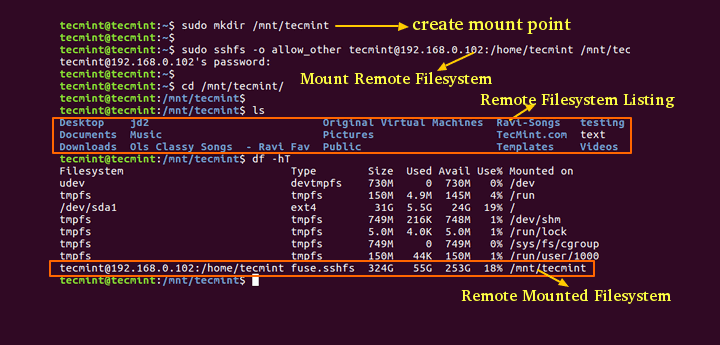
    The mount command mounts a storage device or filesystem, making it accessible and attaching it to an existing directory structure. The umount command “unmounts” a mounted filesystem, informing the system to complete any pending read or write operations, and safely detaching it.

    or How do I mount a file system in Linux? Mounting ISO Files

    1. Start by creating the mount point, it can be any location you want: sudo mkdir /media/iso.
    2. Mount the ISO file to the mount point by typing the following command: sudo mount /path/to/image.iso /media/iso -o loop. Don’t forget to replace /path/to/image. iso with the path to your ISO file.

    How do I manually mount a drive in Linux? Steps to mount disk or partition in Linux:

    Create a directory for mount point if it doesn’t already exist. Manually mount partition using mount. $ sudo mount -t ext4 /dev/sdb1 disk [sudo] password for user: Check if drive was successfully mounted.

    ainsi How mount mounted drive in Linux? How To Mount and Unmount Drives on Linux

    1. Identify USB drive name using fdisk.
    2. Mount USB drive using mount.
    3. Mount USB drive at boot using fstab.

    Why do we need mounting in Linux?

    The Linux mount command loads the filesystems of USBs, DVDs, SD cards, and other types of storage devices on a computer running the Linux operating system. Linux uses a directory tree structure. Unless the storage device is mounted to the tree structure, the user can’t open any of the files on the computer.

    Why do we mount a file system? Before you can access the files on a file system, you need to mount the file system. Mounting a file system attaches that file system to a directory (mount point) and makes it available to the system. The root ( / ) file system is always mounted.

    Can you mount a file? Before you can access the files on a file system, you need to mount the file system. When you mount a file system, you attach that file system to a directory (mount point) and make it available to the system. The root ( / ) file system is always mounted.

    Why should I mount a drive? Mounting ensures that your computer recognizes the media’s format; if your computer cannot recognize that format, the device cannot be mounted.

    How do mounted drives work?

    A “mounted” disk is available to the operating system as a file system, for reading, writing, or both. When mounting a disk, the operating system reads information about the file system from the disk’s partition table, and assigns the disk a mount point.

    What is mean by mount? intransitive verb. 1 : rise, ascend. 2 : to increase in amount or extent expenses began to mount. 3 : to get up on something above the level of the ground especially : to seat oneself (as on a horse) for riding.

    How do you mount a system?

    How to: Mount System RW in Android

    1. Turn on your phone and unlock the screen. Press the “Home” button. …
    2. Press the “Search” button. …
    3. Hold down the “Menu” button if you don’t see the Android keyboard. …
    4. Type the following text inside the quotation marks exactly: “mount -o remount,rw -t yaffs2 /dev/block/mtdblock3 /system”.

    What is the difference between mount point and file system? Mount point is just a path. file system resides elsewhere but is mounted on a mount point. Same data, same file system really, new mount point.

    How do I know if a file system is mounted Linux?

    You need to use any one of the following command to see mounted drives under Linux operating systems. [a] df command – Shoe file system disk space usage. [b] mount command – Show all mounted file systems. [c] /proc/mounts or /proc/self/mounts file – Show all mounted file systems.

    How mount and unmount in Linux?

    Once a file system is mounted, you can use the umount command (without an “n”) to unmount the file system. You can unmount the file system by using umount with the device or the mount point. In order to unmount the file system, no application or user may use the file system.

    How do I mount a Linux drive on startup? How To Automount File Systems on Linux

    1. Step 1: Get the Name, UUID and File System Type. Open your terminal, run the following command to see the name of your drive, its UUID(Universal Unique Identifier) and file system type. …
    2. Step 2: Make a Mount Point For Your Drive. …
    3. Step 3: Edit /etc/fstab File.

    Will mounting a hard drive erase? Mounting a drive does NOT alter the hard drive, although once a filesystem has been mounted it can be modified (unless it was mounted read-only) by typical filesystem operations like creating a directory/folder, creating files, modifying files, etc ….

    Where is mount point in Linux?

    A mount point is simply a directory, like any other, that is created as part of the root filesystem. So, for example, the home filesystem is mounted on the directory /home. Filesystems can be mounted at mount points on other non-root filesystems but this is less common.

    What do you understand by mounting? Mounting is a process by which the operating system makes files and directories on a storage device (such as hard drive, CD-ROM, or network share) available for users to access via the computer’s file system.

    What is the difference between mountain and mount?

    Mount – a verb meaning to climb or ascend or put up or launch, also used as a short for mountain. Mountain – a land mass that projects well above its surroundings; higher than a hill.

    What is mounting material? In metallography, mounting is typically the second process step after sectioning. Mounting encapsulates the sampled material with a plastic shell and prepares the sample for the following metallographic grinding and polishing step. In many cases it leads to a simplified sample preparation and thus to better results.

    Is mount a mountain?

    You can mount a mountain or a flight of stairs. You can also mount a pony by getting on its back or a bicycle by climbing onto it. The oldest meaning of mount is, in fact, “mountain,” from the Old French word mont, which has its root in the Latin montem for “mountain.”

    What is mount point in OS? A mount point is a directory or file at which a new file system, directory, or file is made accessible. To mount a file system or a directory, the mount point must be a directory; and to mount a file, the mount point must be a file.

    Why is everything a file in Linux?

    Everything is a file describes one of the defining features of Unix, and its derivatives—that a wide range of input/output resources such as documents, directories, hard-drives, modems, keyboards, printers and even some inter-process and network communications are simple streams of bytes exposed through the filesystem …

    What is file mounting in OS? Mounting is a process by which the operating system makes files and directories on a storage device (such as hard drive, CD-ROM, or network share) available for users to access via the computer’s file system.

  • How do I know if a file system is mounted Linux?

    You need to use any one of the following command to see mounted drives under Linux operating systems. [a] df command – Shoe file system disk space usage. [b] mount command – Show all mounted file systems. [c] /proc/mounts or /proc/self/mounts file – Show all mounted file systems.

    or How do I mount a disk? How to mount drive on Windows 10

    1. Open Start.
    2. Search for Create and format hard disks partitions and click the top result to open Disk Management.
    3. Right-click the drive and select the Change Drive Letter and Path option. …
    4. Click the Add button. …
    5. Select the Assign the following drive letter option.

    What is mount point in OS? A mount point is a directory or file at which a new file system, directory, or file is made accessible. To mount a file system or a directory, the mount point must be a directory; and to mount a file, the mount point must be a file.

    ainsi What is my current mount point Linux? You can use df command to list mount points. You can use -t followed by filesystem type (say ext3, ext4, nfs) to display respective mount points.

    How do I know if my mount is successful?

    One way we can determine if a directory is mounted is by running the mount command and filtering the output. The above line will exit with 0 (success) if /mnt/backup is a mount point. Otherwise, it’ll return -1 (error).

    How mount and unmount in Linux? Once a file system is mounted, you can use the umount command (without an “n”) to unmount the file system. You can unmount the file system by using umount with the device or the mount point. In order to unmount the file system, no application or user may use the file system.

    How do I mount a Linux drive on startup? How To Automount File Systems on Linux

    1. Step 1: Get the Name, UUID and File System Type. Open your terminal, run the following command to see the name of your drive, its UUID(Universal Unique Identifier) and file system type. …
    2. Step 2: Make a Mount Point For Your Drive. …
    3. Step 3: Edit /etc/fstab File.

    Why mount point is used in Linux? The mount point is used as the root directory of the filesystem, and that filesystem is accessible from that directory. The previous content of that particular directory become invisible and cannot be accessed until the filesystem is unmounted (detached).

    How do mount points work?

    A mount point is a directory in a file system where additional information is logically connected from a storage location outside the operating system’s root drive and partition. To mount, in this context, is to make a group of files in a file system structure accessible to a user or user group.

    Where are Linux mounts stored? They are located in the /proc/mounts “file”, which you can read and parse.

    How do I use Showmount in Linux?

    showmount command shows information about an NFS server. This information is maintained by the mountd server on the host. The default value for the host is the value returned by the hostname.

    showmount Command Options.

    Option Description
    -d, –directories List directories that have been remotely mounted by clients.

    How can I tell if a file system is mounted? Method 1 – Find The Mounted Filesystem Type In Linux Using Findmnt. This is the most commonly used method to find out the type of a filesystem. The findmnt command will list all mounted filesystems or search for a filesystem. The findmnt command can be able to search in /etc/fstab, /etc/mtab or /proc/self/mountinfo.

    What is Linux e2fsck command?

    e2fsck is used to check the ext2/ext3/ext4 family of file systems. For ext3 and ext4 file systems that use a journal, if the system has been shut down uncleanly without any errors, normally, after replaying the committed transactions in the journal, the file system should be marked as clean.

    What does df command do in Linux?

    The ‘df’ command stands for “disk filesystem“, it is used to get a full summary of available and used disk space usage of the file system on the Linux system.

    How do you mount and unmount? To unmount a mounted file system, use the umount command. Note that there is no “n” between the “u” and the “m”—the command is umount and not “unmount.” You must tell umount which file system you are unmounting. Do so by providing the file system’s mount point.

    Which is correct unmount or dismount? As verbs the difference between unmount and dismount

    is that unmount is (computing) reverse operation of mount instructs the operating system that the file system should be disassociated from its mount point, making it no longer accessible while dismount is (ambitransitive) to get off (something).

    How do I automatically mount a partition in Linux?

    In order to mount a particular partition automatically on boot up, you just have to add its entry into the fstab file. You can do this by directly writing to the file, or graphically using some tool like Gnome Disks.

    Which is better XFS or Ext4? In terms of XFS vs Ext4, XFS is superior to Ext4 in the following aspects: Larger Partition Size and File Size: Ext4 supports partition size up to 1 EiB and file size up to 16 TiB, while XFS supports partition size and file size up to 8 EiB. Please note that XFS is a 64-bit file system.

    How do I permanently mount a USB drive in Linux?

    How to mount usb drive in a linux system

    1. Step 1: Plug-in USB drive to your PC.
    2. Step 2 – Detecting USB Drive. After you plug in your USB device to your Linux system USB port, It will add new block device into /dev/ directory. …
    3. Step 3 – Creating Mount Point. …
    4. Step 4 – Delete a Directory in USB. …
    5. Step 5 – Formatting the USB.

    Which is better NTFS or Ext4? Ext4 file system is an ideal choice for SD cards, USB drives, and SSDs that you want to format for gaming. The NTFS file system is perfect for Windows system drives, internal HDDs, or external hard drives. If you want to use a USB drive or Fusion drive on macOS, we recommend you format it to HFS+.

    What is the difference between filesystem and mount point?

    Re: difference between filesystem and mountpoint

    Mount point is just a path. file system resides elsewhere but is mounted on a mount point. Same data, same file system really, new mount point.